







Medical Card for Truck Drivers : Requirements, Cost & Validity Explained (2026)
Driving across state lines trucks commercially is a job and responsibility. Safety on the highways in America begins with the realization that every commercial driver must possess the medical fitness to operate a heavy vehicle. After this comes the application of the DOT medical card, officially known as the Medical Examiner’s Certificate (MEC). As a prospective or existing holder of a Commercial Driver’s License (CDL), you need to know about medical requirements, the fees involved, and the duration of its validity. The following is a complete guide which covers everything that you need to know under compliance well into 2026.
What Is a DOT Medical Card?
A DOT medical card is officially issued to a driver who meets health standards imposed by Federal Motor Carrier Safety Administration (FMCSA) to operate a commercial motor vehicle (CMV) safely. Thus, drivers of vehicles weighing more than 10,001 pounds for transporting hazardous materials or passengers must be medically certified prior to being permitted to drive.
In actual implementation, a DOT medical card proves that a driver has passed a DOT physical examination conducted by an authorized medical practitioner listed in the FMCSA National Register of Certified Medical Examiners.
Who Must Have a Medical Certificate?
If you are a commercial truck driver in the U.S., you generally need a medical examiner’s certificate if you:
- Operate a commercial vehicle in interstate commerce.
- Hold a CDL or Commercial Learner’s Permit (CLP) and drive vehicles that require federal safety compliance.
- Transport hazardous materials or passengers commercially.
Some states also have specific intrastate rules that might apply if you drive exclusively within state boundaries. Always check with your state DMV or licensing agency for local requirements.
Medical Card Requirements: What the DOT Exam Covers
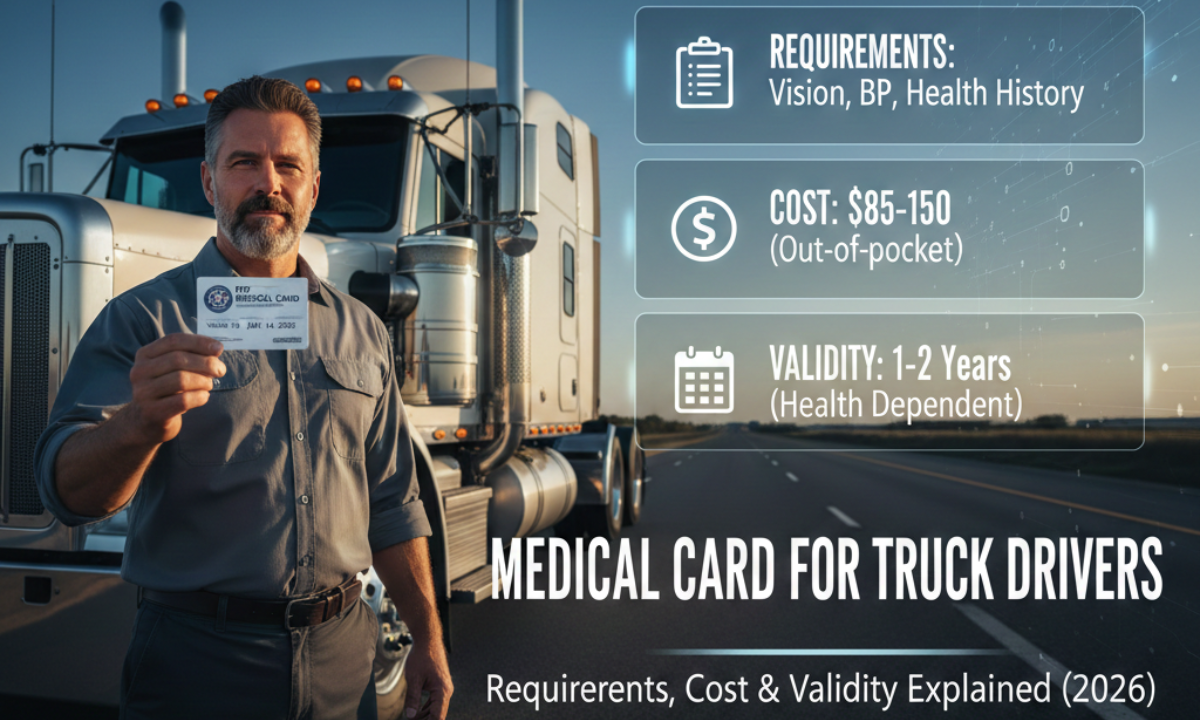
A DOT physical exam assesses whether a driver meets minimum health standards. The focus is on physiological and safety-related criteria, including:
- Vision and hearing acuity
- Blood pressure and cardiovascular health
- General physical fitness and neurological responses
- Overall health history review and medication considerations
The examination is designed to identify conditions that might impair safe driving, such as poorly managed hypertension, sleep apnea, or uncontrolled diabetes.
Only FMCSA-certified medical examiners listed on the National Registry can perform this exam and issue a valid medical card
Step-by-Step: How to Get Your DOT Medical Card
- Find an Authorized Examiner
- Check FMCSA National Registry for listings of certified examiners in your area.
- Schedule the DOT Physical Exam
- Carry your ID and driving credentials to the appointment.
- Complete the Examination
- Doctor will evaluate the following: vision, hearing, blood pressure, reflexes, and other health markers.
- Receive Your Medical Examiner’s Certificate
- After successful completion, the examiner shall proceed to issue the MEC. The MEC can be submitted electronically to the FMCSA and the state, while a signed copy is retained by the successful candidate.
- Submit to State DMV (if required)
- Some states require you to submit proof of certification to the local licensing agency for them to update your CDL record.
Cost: How Much Does a DOT Medical Card Cost?
The cost of obtaining a DOT medical card depends on the location chosen and the provider, as well as any additional tests carried out. Typical costs could be in the following ranges:
- Standard exam fee: $85 to $150, generally; some providers get a little more in urban markets.
- Clinic fees: Some clinics have routine charges starting from say, $50 to $150.
- Supplemental testing: Whether you will incur any further cost beyond the base rate will depend on whether you require any additional testing (e.g. sleep study).
Most drivers pay this out of pocket, -their health insurance doesn’t usually cover the cost of a regulatory exam. Many employers will reimburse or sponsor DOT physicals as an aspect of compliance.
Validity: How Long Is a DOT Medical Card Good For?
Once obtained, a DOT medical card is usually valid for:
- 24 months (2 years) for drivers without grave health concerns.
- 12 months or less for those with certain controlled health conditions requiring closer monitoring.
Your Medical Examiner’s Certificate will indicate its exact date of expiration, and it is your sole responsibility to keep track of that date. Once you fail to comply, your CDL medical qualification will lapse and you may not be qualified for operating a CMV until renewed.
Why Compliance Matters: Legal & Career Impact
Driving without a valid DOT medical card can have dire consequences:
- Penalties and Fines – Federal and state enforcement can issue citations.
- CDL Suspension or Downgrade – Your CDL might be restricted or invalidated without current medical certification.
- Changes in your employment status – A lot of carriers require that you have active DOT certification for hiring and continued employment.
Keeping your medical card valid is a key aspect of career longevity and compliance in the trucking industry.
Final Thoughts
In the United States, DOT Medical Card acquisition and maintenance is a vital prerequisite for the functioning of truck drivers. Great knowledge of the standards, estimated fees, and validity durations will keep a driver compliant with FMCSA stipulations, protecting their career and enabling the avoidance of costly fines.
With proper planning, drivers can have their DOT physicals done well ahead of time to prevent any downtime in commercial vehicle driving eligibility. If local examiners are needed or state-specific submissions are required, I can provide that information next.